T
he film explores the idea of how people must go through their personal Odyssey to reach their destination with an unbelievable poetic quality. The basic tale is that a nameless exiled Greek-American filmmaker named A (played by Harvey Keitel ) returns to the Balkans after thirty-five years , and is seeking to find three lost reels of footage from the earliest known extant Greek film , made by the Manakis brothers in 1905. His quest takes him across changing countries , bounders and war torn cities. The Romanian actress ,Maia Morgenstern, plays the parts of the four women. These women can easily be identified with the women Homer's Ulysses came across during his voyage. They also represent all the women whom "A" had loved and lost in past. The search for the reels of film works as a metaphor for a search for the common history of the Balkan countries. His odyssey , from Ptolemais through Albania ,Bulgaria and Romania , to Belgrade and Sarajevo, allows for a reflection on changing borders , national identity, and the relationship of film to historical and political reality. Keitel speaks mostly in English, while most of the other characters speak in Greek and other native languages. Keitel gives a good performance in this film about a man's search for missing film reels. But the best performance of the film comes from Maia Morgenstern . She is brilliant.
Giorgos Arvanitis, Angelopoulos's long time collaborator ,is responsible for the stunning cinematography. Many of the scenes are long shots ,that are also long takes , lasting several minutes, Angelopoulos's great signature. The direction is great -beautiful scenery , wonderful mesmeric tracking shots and long takes make for a great visual experience. However working in several languages takes it's toll and much of the English narration is weak and clumsy.
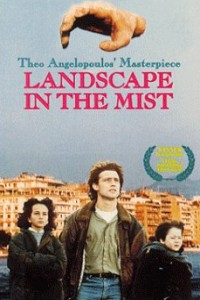
Landscape in the mist is a 1988 film directed by Theo Angelopoulos. This film tells the journey of two children in search of their father. They are told that their father lives in Germany. On Their journey ,they encounter many odd incidents and people before reaching to Germany.
The two most significant encounters stand-out. They meet a brutish truck driver who rapes the girl . The scene was quite disturbing. When the girl is raped in the back of a truck, the camera slowly moves on the tarp beclouding the incident, ending in a close-up of her hand stained with blood from her violated hymen. They meet a friendly gay-biker named Orestes and the girl gets attracted towards him.
Much like the Theo's previous works, this is also a film that relies heavily on the delicate use of color. They reflect pain,happiness and disappointment. Yet this is not a film of visual contrasts. It very much feels as something Andrei Tarkovsky would direct. This is gloomy,misty and almost mesmeric at-times. On their journey, they learn the realities of life-cruelty, violence and the struggle for survival. This cinema is filled with symbolism. In a particular scene, joy and sorrow are revealed simultaneously as a horse dies before their eyes, even as a marriage is cheerfully celebrated nearby.
To conclude, Angelopoulos portrays a journey of two children whose introduction to the real world has been nothing but a misguided jump into the unknown and people do usually fear what they do not understand. The film is filled with unforgettable instances that are simultaneously real and hallucinatory, seeping into the surreal. This is not my favourite Angelopoulos but worth a watch.